


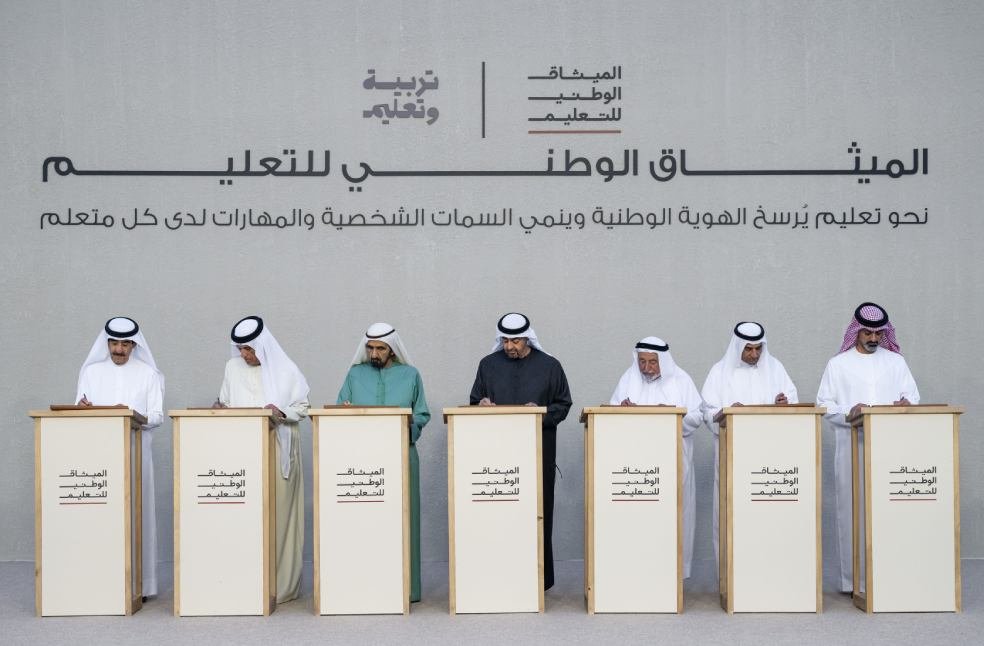
The UAE has unveiled the National Education Charter, establishing a comprehensive framework that defines the profile of the Emirati graduate and outlines the values, competencies and future skills that will guide the nation’s education journey.
The Charter reinforces education as a sovereign priority and a central pillar of human development and nation-building, ensuring long-term policy alignment and institutional continuity.
Signed in the Presence of UAE Leaders
The Charter was signed at Qasr Al Bahr in the presence of:
- Sheikh Mohammed bin Rashid Al Maktoum, Vice President, Prime Minister and Ruler of Dubai
- Sheikh Dr Sultan bin Mohammed Al Qasimi
- Sheikh Hamad bin Mohammed Al Sharqi
- Sheikh Saud bin Rashid Al Mualla
- Sheikh Saud bin Saqr Al Qasimi
- Sheikh Ammar bin Humaid Al Nuaimi
The launch coincided with Emirati Day for Education on 28 February, underscoring the symbolic importance of the occasion.

Education as a Strategic National Priority
President Sheikh Mohamed bin Zayed Al Nahyan described education as the cornerstone of the UAE’s development journey. He emphasised that investing in the Emirati citizen remains the true guarantee of sustainable prosperity and long-term progress.
The Charter defines the Emirati learner as:
- Proud of national identity
- Rooted in Arabic language and Islamic values
- Equipped with advanced cognitive and practical skills
- Prepared to lead in a rapidly changing global environment
A Unified National Ecosystem
The framework places human development at its core while strengthening governance across the education sector. It highlights education as a shared responsibility involving schools, families and the wider community.
By articulating a values-driven, globally competitive and future-ready model, the National Education Charter serves as a long-term roadmap to reinforce national identity, safeguard achievements and prepare future generations to lead with confidence and capability.