


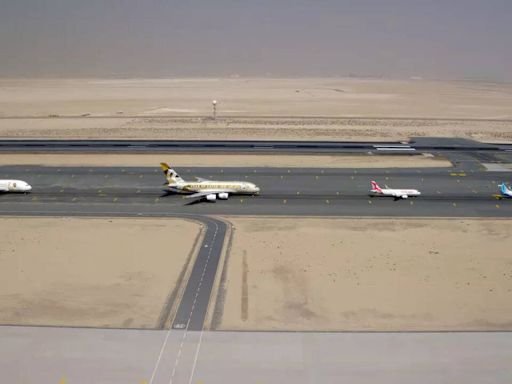
Hundreds of thousands of passengers have been stranded or diverted after multiple Middle Eastern countries shut their airspace following military strikes involving the United States, Israel and Iran. Major aviation hubs including Dubai, Abu Dhabi and Doha temporarily halted or severely reduced operations, disrupting one of the world’s busiest global transit corridors connecting Europe, Africa and Asia.
According to aviation analytics firm Cirium, nearly 23 percent of flights scheduled to land in the Middle East on Saturday were cancelled, with total cancellations exceeding 1,800 when outbound flights were included. Flight tracking services also reported tens of thousands of global delays. Airlines have been forced to reroute aircraft south over Saudi Arabia, adding flight time, fuel costs and operational pressure. Aviation experts warned travellers to expect continued delays and possible fare increases if the disruption persists.

Several major carriers suspended services across the region, including Air India, Turkish Airlines, Delta, United, Lufthansa, British Airways and others. Countries including Iran, Israel, Qatar, Iraq, Kuwait and the UAE imposed full or partial airspace closures. Authorities indicated that some sections of airspace may gradually reopen depending on security assessments, but the duration of disruptions remains uncertain. Airlines have advised passengers to check flight status updates before travelling and have issued waivers to allow rebooking without penalty.