


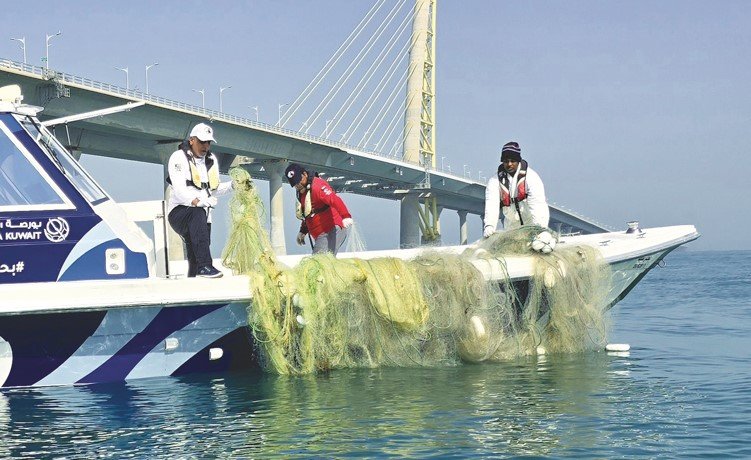
A Kuwaiti diving team from the Environmental Voluntary Foundation has successfully removed around one tonne of abandoned fishing nets from Kuwait Bay and the Fintas coastal area, as part of ongoing efforts to protect marine life and ensure safe navigation at sea. The operation was carried out in cooperation with the General Directorate of Coast Guard and Marine Rescue.
Team leader Waleed Al-Fadhel told KUNA that the discarded nets posed a serious danger to marine ecosystems, as they trap and injure fish and other sea creatures. Using specialized, environmentally safe techniques, the team was able to free trapped animals and remove the debris without causing further harm to the affected areas.
Al-Fadhel explained that abandoned fishing nets, often referred to as “ghost nets,” are among the most hazardous forms of plastic pollution. They can persist in the sea for centuries, continuing to entangle turtles, dolphins, and fish, destroy coral reefs, and obstruct maritime navigation—posing risks to fishermen and other sea users.

He noted that the cleanup forms part of a broader long-term strategy to conserve Kuwait’s marine environment. This includes the management of 108 marine moorings near coral reef sites and the Jaber Kuwait Marine Reserve, which features 25 artificial reef colonies.
The team is also involved in coral cultivation, the recovery of sunken boats and vessels, and ongoing monitoring of coral reef health in collaboration with the University of Queensland. In addition, they continue their educational mission by publishing books and visual materials that showcase the richness of Kuwait’s marine biodiversity and promote environmental awareness.
Al-Fadhel urged fishermen and sea-goers to avoid fishing in restricted areas or near the coast and to comply with official regulations, stressing that marine protection is a shared national responsibility. He also called on the public to immediately report any entangled fishing nets—particularly near coral reefs—to the diving team, Coast Guard, Environment Public Authority, or Marine Rescue Department to ensure swift removal and reduce environmental and navigational risks.